October 2nd–3rd, 2026
Professor Paul Barba (History, lead organizer) offered these remarks to open the Symposium:
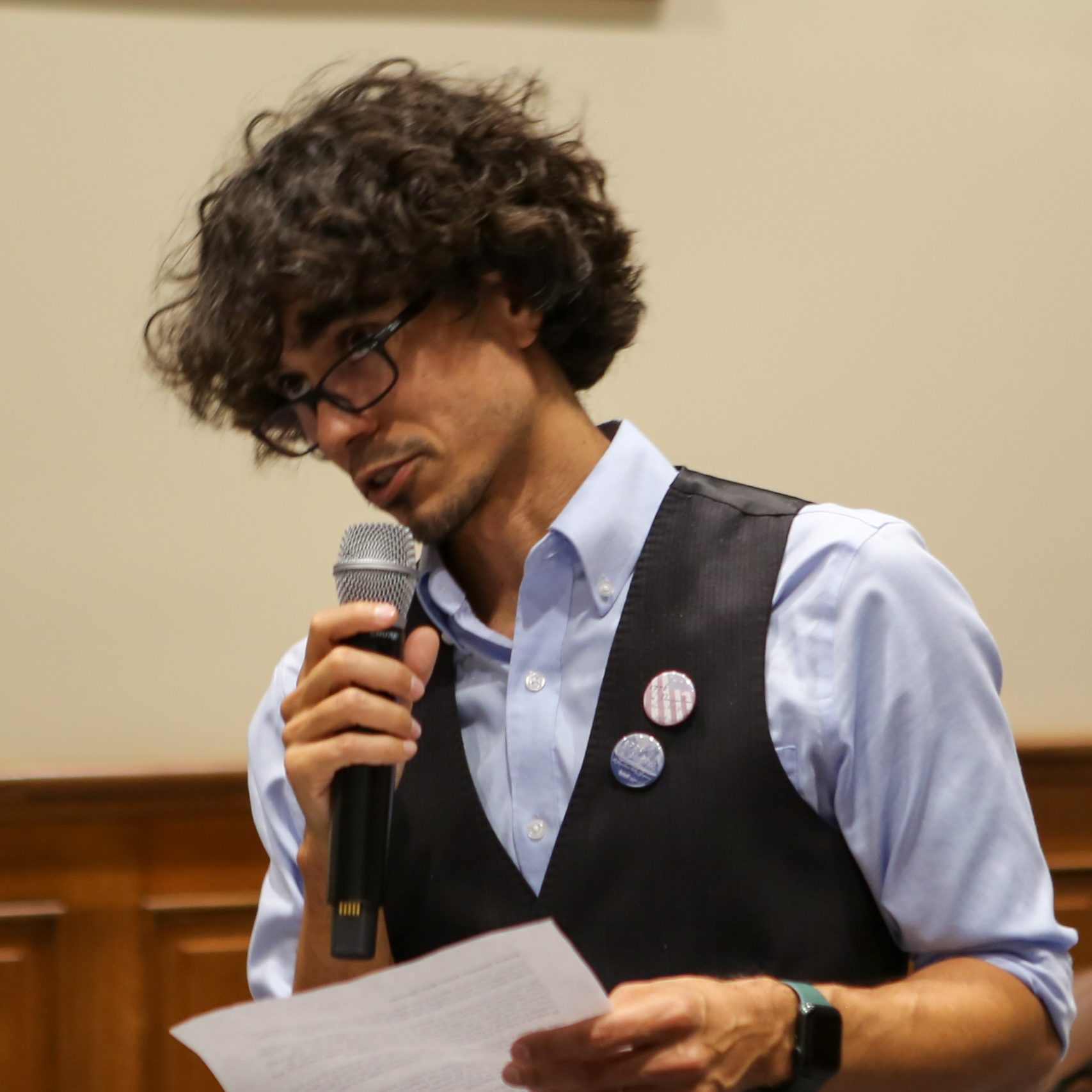
Thank you, everybody, for joining us today. For those who don’t know me, I’m Paul Barba, associate professor of history and the Humanities Center associate director here at Bucknell. I want to start off by saying that my co-organizers, Prof. David Del Testa, Prof. Kate Bermingham, and Prof. Claire Campbell, and I are truly grateful for this opportunity to bring so many scholars, historians, and other custodians of the past together to ruminate on the 250th anniversary of the founding of the United States. The BHC and the symposium organizers would like to thank our sponsors, including the History Department, the Political Science Department, the English Department, the Bucknell Initiative for Dialogue and Democracy, the Center for Social Science Research, the Center for Community Engaged Leadership, Learning, & Research, Weis Markets, and our Anonymous Donors. Without their contributions the events and goodies we have for all of you today and tomorrow would not be possible.
This year, I think, has been a strange year for reflecting on the founding of the United States. I say this because, to an extent, the commemorations I’ve witnessed and read about have defied a lot of my expectations (both high and low expectations, to be clear). This almost certainly has to do with the cultural context of today. America at times feels as divided and as fraught as it was in the 1760s and 70s, when militant dissidents weaponized consumer purchasing power, confiscated and destroyed private property, and ridiculed unpopular officials in the streets, or when women were dragged out of their homes and publicly shamed, made to answer for the decisions and allegiances of their fathers and husbands, or even when government agents fired into crowds of angry protestors as terrified bystanders looked on. In light of the politics of today, these events from 250 years ago don’t feel so foreign or distant.
But instead of reckoning with these echoes—or, perhaps even, legacies—our leaders hold mixed martial arts bouts on the White House lawn, embracing spectacle and jingoism over substance and deep reflection. Still, I’ll give credit where credit is due: The pageantry, the pomp, the ostentatious display, is actually nothing new in American history.
Such was, in fact, the subject of William Lloyd Garrison’s ire in 1829 when he skewered his fellow citizens for betraying the call of the Declaration of Independence in favor of what he termed “the perversion of reason and the madness of intemperance.”
Reflecting on the promises not delivered by the Union more than five decades later, Garrison lamented his contemporaries’ Independence Day celebratory displays. ”Patriotism,” he declared, “has degenerated into mere animal indulgence; or, rather into the most offensive personalities. Liberty has gone hand in hand with licentiousness—her gait unsteady, her face bloated, her robe bedraggled in the dust…. The love of country has been tested by the exact number of libations poured forth, the most guns fired, the greatest number of toasts swallowed, and the loudest professions of loyalty to the Union, uttered over the wine-cup.” (Oh, how familiar this all sounds….)
The injustices of his times, particularly the ongoing enslavement of millions of African Americans, Garrison instead argued, “should make this [4th of July] a day of fasting and prayer, not of boisterous merriment and idle pageantry—a day of great lamentation, not of congratulatory joy.” Reflection and betterment were the worthy lessons of independence.
Garrison, of course, was hardly alone in his condemnation of unthoughtful 1776 celebration. In an 1855 letter to Transylvania College Professor George Robertson, Abraham Lincoln bemoaned the country’s betrayal of its Revolutionary lineage when it came to the question of slavery’s ultimate extinction within the nation: “On the question of liberty, as a principle,” Lincoln wrote, “we are not what we have been. When we were the political slaves of King George, and wanted to be free, we called the maxim ‘that all men are created equal’ a self-evident truth; but now when we have grown fat, and have lost all dread of being slaves ourselves, we have become so greedy to be masters that we call the same maxim ‘a self-evident lie.’ The fourth of July has not quite dwindled away,” he wryly concluded, “it is still a great day—for burning firecrackers!!!” At least in this regard, Lincoln and Garrison could see eye to eye.
And although Frederick Douglass’s Independence Day speech before an abolitionist crowd in Rochester, New York, in 1852 is probably his best-known (and extremely critical) commentary on the legacies of 1776, over a decade later in early March of 1863, Douglass actually drew on the Revolution for inspiration. As he explained to his free Black audiences in his call to arms on behalf of the Union in the Civil War, there was reason to trust Massachusetts’ efforts to mobilize a regiment of Black troops: “We can get at the throat of treason and slavery through the State of Massachusetts. She was first in the War of Independence, first to break the chains of her slaves, first to make the black man equal before the law, first to admit colored children to her common schools, and she was first to answer with her blood the alarm-cry of the nation, when its capital was menaced by rebels.” To Douglass, the promises of the American Revolution lived on through both Massachusetts and Black soldierly sacrifice.
So it is, I hope, in the spirit of William Lloyd Garrison, Abraham Lincoln, and the great Frederick Douglass that we convene today—not to celebrate unthinkingly, through a patriotism by rote—but to reflect on and explore broadly the American Revolution and its many diverse, contested meanings and legacies. We could do much, much worse than to follow in the footsteps of Garrison, Lincoln, and Douglass. Thank you!